No clinician can give a reliable session count from tattoo size alone. Ink colour, pigment depth, layering, location, skin type, scarring and your body’s clearance response all change the course. By the end, you will know which details drive the estimate, why appointments are spaced apart and what a responsible consultation should discuss.
Key takeaways
- Wait six to eight weeks between treatments for recovery and pigment clearance.
- Dark, dense or layered ink usually needs a longer treatment course.
- Ask how tattoo size, location, skin type and tanning affect safe settings.
- Request a session estimate based on ink colours, density, scarring and medical history.
Why tattoo removal appointments are spaced six to eight weeks apart
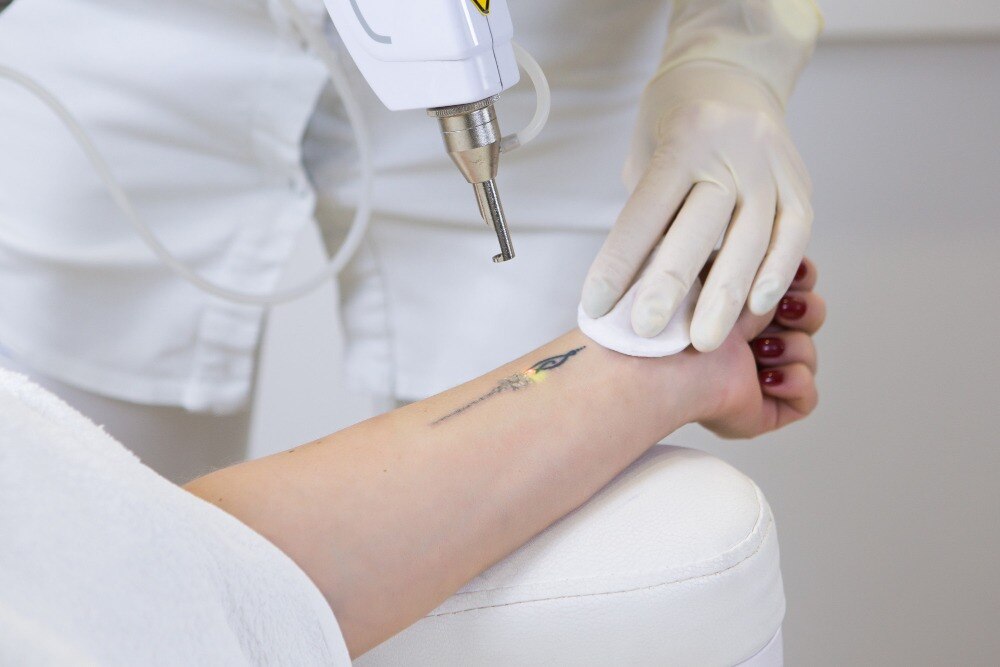
Six to eight weeks between treatments gives your skin time to recover and your body time to remove fragmented pigment. The laser causes ink particles to break apart; your immune response then carries them away through lymphatic clearance. Visible fading can continue throughout this interval, so treating more frequently does not automatically produce faster removal.
There is no reliable fixed number of tattoo removal sessions because the course depends on findings that differ from one tattoo and one person to another:
- Ink colour, density and depth
- Tattoo age and size
- Professional, amateur or cover-up application
- Location and local circulation
- Skin tone, scarring and tissue changes
- Your immune response and the pigment’s clearance rate
The American Academy of Dermatology reports that many patients need about 6–10 laser treatments, but that range is not a promise. A clinician who guarantees an exact total before examining the tattoo is giving you a marketing number, not a dependable estimate.
Treating again before the skin has settled can increase redness, blistering, irritation and the risk of pigment changes. It also leaves less time for fragmented ink to clear, so an early appointment may add inflammation without shortening the overall course.
Some tattoos need longer than 6–8 weeks between treatments, particularly when healing is slow or fading remains active. Complete removal is not guaranteed; ghosting, residual pigment or texture changes can remain.
Ink colour and density can change the treatment course
Pigment colour can change the number of sessions because each colour absorbs different laser wavelengths. Black tattoo ink and dark-blue ink often respond more efficiently than brighter or mixed pigments, but response still depends on how much ink the tattoo contains.
| Pigment group | Typical treatment implication | Why |
|---|---|---|
| Black tattoo ink | Often clears more efficiently | It absorbs laser energy across useful wavelengths |
| Dark-blue ink | Often responds well | Its pigment behaves similarly to black under some wavelengths |
| Green tattoo ink | Can require additional sessions | Green pigments need a wavelength that matches their composition |
| Yellow and orange pigment removal | Often takes longer or remains incomplete | These colours absorb less effectively with commonly used wavelengths |
Ink density matters as much as colour. A heavily packed professional tattoo contains more pigment for each treatment to fragment and for your body to clear. A lightly applied tattoo can fade faster even when it covers more skin.
Pigment depth adds another obstacle. Deeply deposited ink sits farther into the dermis, while a cover-up can place a newer layer over older pigment. The upper layer may need substantial reduction before the laser can reach and treat the older design effectively.
Several colours or multiple layers can therefore extend the course beyond that of a single, lightly applied black tattoo. Residual pigment, ghosting, or colour change can remain, so complete return to unmarked skin is not guaranteed.
Size, layers and location matter more than area alone
A small tattoo can need more sessions than a larger one when it contains dense pigment, sits in a difficult location, or has been applied over older ink. Area measures skin coverage; it does not show how much pigment the laser must fragment or how efficiently your body can clear it.
Small tattoos become harder when they have:
- Heavy saturation from a professional tattoo, which usually places more ink deeper and more uniformly than an amateur tattoo.
- Several tattoo ink layers, as seen in a cover-up tattoo. The newer pigment may need reduction before the older design becomes reachable.
- Scar tissue or altered skin, which can limit treatment settings and slow visible fading.
- Placement on the foot, ankle, or lower leg, where circulation and lymphatic clearance are poorer than on the head, neck, or upper trunk.
- Resistant colours or cosmetic pigments that respond less predictably than lightly applied black ink.
A larger, lightly applied amateur tattoo can therefore fade more efficiently than a compact, densely packed professional tattoo. The Kirby–Desai scale reflects this difference by weighing location, colour, ink amount, tissue change, skin type, and whether the tattoo was professionally or traumatically applied—not size alone.
Ask how deep the pigment appears, whether a cover-up is present, and whether the location is likely to clear slowly. A newer picosecond laser does not automatically reduce sessions; wavelength, fluence, spot size, and correct pigment matching still determine how effectively each treatment breaks the ink.
Skin type, tanning and scarring affect safe treatment settings
A higher Fitzpatrick skin type usually changes the safety margin, not the tattoo’s chemistry. More conservative laser settings can lower the risk of hyperpigmentation or hypopigmentation, but they may also slow clearance and increase the number of sessions. Darker skin is not inherently unsuitable for removal.
Recent tanning before tattoo removal increases melanin in the skin, so treatment may be postponed until the tan fades. Treating tanned skin raises the risk of burns and uneven pigment change; use broad-spectrum sunscreen and avoid deliberate tanning between appointments.
Scarring adds a separate limitation: a laser can break up ink without restoring scarred texture. Keloid-prone skin or existing textural change raises complication risk, and the realistic endpoint may be lighter pigment rather than perfectly smooth, unmarked skin.
Tell the clinician about medical factors that could change timing or settings:
- Photosensitising medicines, which can increase light-related reactions
- Immunosuppressive treatment or a condition that weakens immune response
- Poor wound healing or uncontrolled diabetes
- An active infection near the tattoo
These findings can require medical clearance, a treatment delay, or a slower course. A promised exact session count is unreliable when pigmentary risk, scarring, or healing response limits how aggressively the tattoo can be treated.
What a consultation should measure before estimating sessions
A realistic estimate starts with findings, not tattoo size: the clinician should document location, colours, ink density, pigment depth, layers, skin type, scarring, application method, and how your skin heals. A tattoo removal consultation should also define the endpoint—near-invisibility, not guaranteed unmarked skin—because residual pigment, ghosting, altered colour, or texture changes can remain.
| Finding | What the clinician checks | Why it changes the estimate |
|---|---|---|
| Location | Foot, ankle, hand, trunk, or another site | Circulation and clearance differ by body area |
| Colour and composition | Black, blue, green, yellow, white, flesh-toned, or cosmetic tattoo pigment | Pigments respond differently; titanium dioxide or iron compounds can darken |
| Ink amount and depth | Dense packing, faded ink, and how deeply pigment sits | More pigment or deeper pigment needs more clearance |
| Layers | Cover-up, multiple colours, or an older tattoo beneath newer ink | The upper layer can hide the older one |
| Tissue condition | Scarring, raised areas, altered texture, or previous treatment | Scarred tissue can limit safe treatment settings |
| Skin and application | Fitzpatrick skin type, tanning, professional or traumatic application | Safety limits and pigment distribution affect progress |
The Kirby–Desai scale combines these six difficulty factors and helps replace a size-based guess with a more defensible range. Your clinician should also review healing history, immune or lymphatic conditions, medications, and treatment response between appointments.
A cautious test spot is especially important for white, pink, flesh-toned, or cosmetic pigment. Dr. Richa's Unique Clinic (Call : 08048034690) can use that early response to refine settings and the session estimate rather than promise a fixed endpoint.
Related items
It’s possible that at some point in life, you would like to reverse the decision that led to your permanent tattoo. View product → |
TATTO REMOVAL by Q-switched machines is a technique for removing unwanted tattoos from the skin that uses Q-switched lasers. View service → |
Frequently asked questions
Why are tattoo removal appointments spaced six to eight weeks apart?
The interval allows skin to recover while the immune system clears fragmented pigment. Fading can continue between appointments, so treating sooner does not automatically speed removal.
How do ink colour and density affect tattoo removal sessions?
Different ink colours respond differently to laser wavelengths, while dense pigment gives the body more ink fragments to clear. Multiple ink colours or heavy saturation can extend the treatment course.
Do tattoo size, layers and location affect the number of sessions?
Yes. Size matters, but layered cover-up ink, dense designs and locations with slower circulation can influence treatment time and the number of appointments more than surface area alone.
How do skin type, tanning and scarring affect tattoo removal treatment?
Your skin type and current tan affect the safe laser settings and the risk of pigment changes. Scar tissue also requires assessment before a clinician estimates treatment sessions.
What should a consultation measure before estimating tattoo removal sessions?
A consultation should assess ink colours, pigment density, tattoo dimensions, cover-up layers, location, skin type, tanning, scarring and your medical history.
Keywords